In the production of soybean oil, we know that there is leachable soybean oil and pressed soybean oil, and we know what heavy craftsmanship is needed after pressing soy oil to be packaged into finished products, let us eat it. Here are five points to take a look at the five most important processes that soybean oil needs to do after pressing. What are the key functions of these five processes in the mainland?
[1] Soybean oil deacidification process
The deacidification process of soybean oil is mainly one of the refining methods of soybean oil manufacturers in the process of preparation. The deacidification method of soybean oil is neutralized with trisodium phosphate and then separated by a centrifuge.
[2] Soybean oil decolorization process
The decolorization process of soybean oil is mainly one of the refining methods of soybean in the process of preparing high-quality soybean oil. The traditional decolorizing agent used for decolorization of edible oil is activated clay and activated carbon.
[3] Soybean oil deodorization process
Unsaturated fatty acids in oils and fats are prone to produce trans fatty acids. Therefore, in the processing of oils and fats, the harm of trans fatty acids to human health has received more and more attention in countries around the world. Therefore, research and comparison on the effects of deodorization process conditions on trans fatty acid content in different oils have attracted wide attention. Deodorization is often carried out when processing high-quality fat products. Deodorization of oil can not only remove odor substances in oil, improve the smoke point of oils and fats, improve the flavor of edible oils, but also effectively improve the safety of oils and fats.
[4] Soybean oil degumming process
The degumming of soybean oil can be simply described as: adding water to the hair oil, the hydrated gum (phospholipid) is insoluble in oil and can be separated from the oil. Although this process is simple and reliable, it is not easy to remove the gum and achieve satisfactory results with minimal loss of neutral oil. The gums in edamame oil include oil-soluble lipids and acetone-insoluble matter. However, the typical soybean oil gum has great hydrophilicity. After water absorption, the specific gravity is increased to facilitate separation from oil, which is more beneficial for soybean oil manufacturers to produce high quality soybean oil and natural soybean oil.
[5] Soybean oil degreasing process
The degreasing process of soybean oil is mainly one of the refining methods of soybean in the process of preparation. The degreasing of soybean is soybean meal, and the non-fat is soybean. It is better to label the raw materials with defatted soybeans. It is not good to use "bean meal". The actual defatted soybean is bean cake (bean meal).
What is the vegetable oil refining process?
Process Description of Vegetable Oil Refining is as follows.
Water Degumming :
Water Degumming is first step in the Edible Oil Refinery Process. Oils contains Hydratable Phosphatide which absorb the water, that Hydratable Phosphatides are oil- insoluble which easily separated by centrifuge.
Water Degummed Gums are further process to convert into Lecithin and it is much demanded product in the market.
Alkali Refining :
Next step in Edible Oil Refinery is the is the traditional method used in past centuries and widely practiced form of refining method by treatment of the fats and oils with an alkali solution. The free fatty acid are converted into water soluble soaps which are removed by separators. Phospholipids, carbohydrates and proteins additionally can be changed to water soluble substances with hydration. When the Alkali Refining treatment, the fats and oils area unit washed with water to get rid of residual water soluble soaps after that oil passes in vacuum Dryer to remove Moisture.
Bleaching :
Next step in Edible Oil Refinery is the OIL received from previous stages contains traces of soap, iron and few ppm of Phospholipids and Carotenes, these contents area unit undesirable and needed to be removed in Bleaching Operation, leaching Plant includes Steam Agitated Bleacher comprises of an acid treatment, a separate oil and earth compounding device with mechanical mixer (this arrangement ensures no carryover of bleaching earth into vacuum system), main bleaching vessel and Hermetic filters.
Bleaching Process Flow Diagram

De-Waxing / Winterization :
Next step in Edible Oil Refinery is A very easy demand of this method is to clear, good refined oil to satisfy bound specifications of cloud point.
We offers an ideal and extremely Effective Crystallization and Filtration Method. It's composed of Homogenizer, Crystallizer and self filter instrumentation with sequence cooling system.
We have developed an ideal dynamic coil Designed Crystallizer for Guaranteed 100% Uniform Cooling especially for Rice Bran Oil, Sunflower Oil & Cottonseed Oil and is already in operation with our valued consumer for highest quality of product. We tend to conjointly provide low budget crystallizer.
Self improvement filter instrumentation is also a modern style, having the ability of Maintaining Filtration Temperature and isn't laid low with close Temperature.
We area unit one in every of the foremost leading manufacturer and provider in India in the field of De-waxing Plants,Winterization Plant, self-cleaning filter equipment and dynamic coil designed crystallizer for uniform cooling.
Dewaxing Process Flow Diagram

Winterization Process Flow Diagram

Deodorization :
Next step in Edible Oil Refinery is the Deodorization Plant. We are leading manufacturer of oil Deodorization Plant which is best for Soybean Oil Refining, Sunflower Oil Refining, Cottonseed Oil Refining, Rice Bran Oil Refining, Mustard Oil Refining etc.
Deodorization process is used to remove unacceptable odour by steam distillation the odoriferous compound area unit strip off with the assistance of live injected steam into heated oil under high vacuum.
Physical Refining :
Next step in Edible Oil Refinery is the Physical Refining method is employed to get rid of free fatty acid using Steam Distillation technique at warm temperature and under high vacuum and it is followed by Deodorization and an extra technical facility is else before deodorization for removal of free fatty acid.
Physical Refining Process Flow Diagram
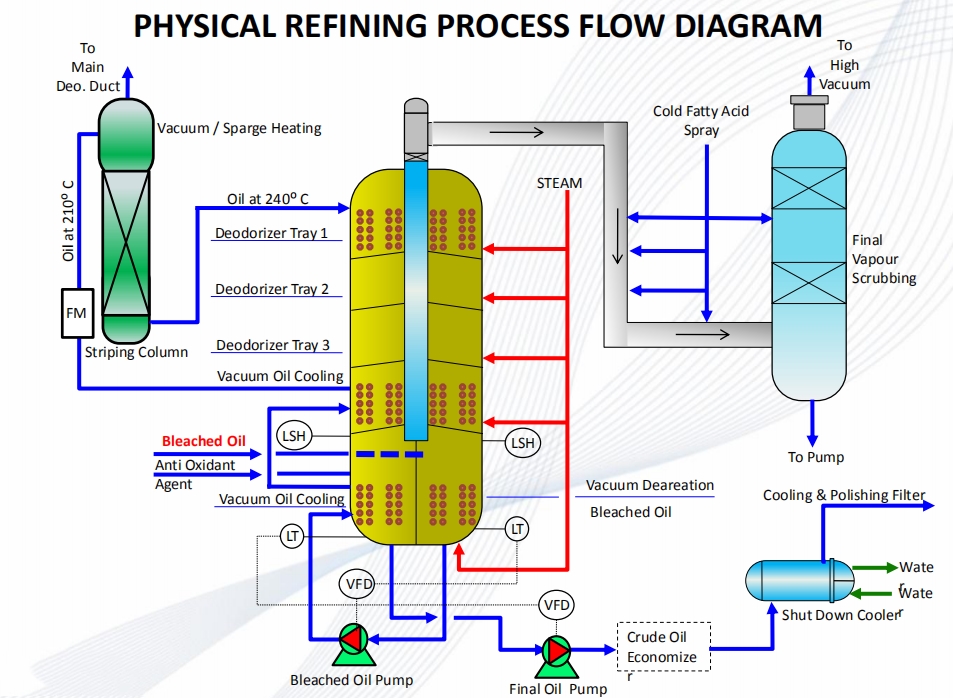
Fractionation :
Next step in Edible Oil Refinery is the Fractionation Plant is specialized to supply provide a low operating cost fractionation plant, which provides high Olein/soft Stearin yields at established management. We offer PLC (automation) for efficient working and reliability of the fractionation plant.
The separation of stearin & olein is continuously done on rotary vacuum drum filter / plate and frame filter and its principle is easy, whereas crystallization method involves an executive technique to develop and grow the particles size for simple & swish separation of stearin & olein.Our technique ensures you a perfect technology.
Acid Oil Plant :
Next step in Edible Oil Refinery is the Acid Oil Plant. We has designed an Environmental Friendly process for Acid Oil Plant and acid oil obtain from soap stock which coming from Alkali Refining of Oils and Fats etc. Soap Stock contain wash water, Bad quality of recovered oil. Soap Stock is pumped through screw pump to the Acid reactor for splitting. Soap stock charge in reactor and boiled in terms drying with steam heating cum agitation coil. After removing maximum Moisture pre calculated amount of acid (H2SO4) or HCL is added slowly. Splitting is done underneath continuous observation thus on maintain applicable acid value of final product to avoid excess acid consumption.
Application: Vegetable Oil, Palm Oil, Sunflower Oil, Cottonseed Oil, Soybean Oil, Groundnut Oil, Ricebran Oil & Mustard Oil.
Water Degumming :
Water Degumming is first step in the Edible Oil Refinery Process. Oils contains Hydratable Phosphatide which absorb the water, that Hydratable Phosphatides are oil- insoluble which easily separated by centrifuge.
Water Degummed Gums are further process to convert into Lecithin and it is much demanded product in the market.
Alkali Refining :
Next step in Edible Oil Refinery is the is the traditional method used in past centuries and widely practiced form of refining method by treatment of the fats and oils with an alkali solution. The free fatty acid are converted into water soluble soaps which are removed by separators. Phospholipids, carbohydrates and proteins additionally can be changed to water soluble substances with hydration. When the Alkali Refining treatment, the fats and oils area unit washed with water to get rid of residual water soluble soaps after that oil passes in vacuum Dryer to remove Moisture.
Bleaching :
Next step in Edible Oil Refinery is the OIL received from previous stages contains traces of soap, iron and few ppm of Phospholipids and Carotenes, these contents area unit undesirable and needed to be removed in Bleaching Operation, leaching Plant includes Steam Agitated Bleacher comprises of an acid treatment, a separate oil and earth compounding device with mechanical mixer (this arrangement ensures no carryover of bleaching earth into vacuum system), main bleaching vessel and Hermetic filters.
Bleaching Process Flow Diagram
De-Waxing / Winterization :
Next step in Edible Oil Refinery is A very easy demand of this method is to clear, good refined oil to satisfy bound specifications of cloud point.
We offers an ideal and extremely Effective Crystallization and Filtration Method. It's composed of Homogenizer, Crystallizer and self filter instrumentation with sequence cooling system.
We have developed an ideal dynamic coil Designed Crystallizer for Guaranteed 100% Uniform Cooling especially for Rice Bran Oil, Sunflower Oil & Cottonseed Oil and is already in operation with our valued consumer for highest quality of product. We tend to conjointly provide low budget crystallizer.
Self improvement filter instrumentation is also a modern style, having the ability of Maintaining Filtration Temperature and isn't laid low with close Temperature.
We area unit one in every of the foremost leading manufacturer and provider in India in the field of De-waxing Plants,Winterization Plant, self-cleaning filter equipment and dynamic coil designed crystallizer for uniform cooling.
Dewaxing Process Flow Diagram
Winterization Process Flow Diagram
Deodorization :
Next step in Edible Oil Refinery is the Deodorization Plant. We are leading manufacturer of oil Deodorization Plant which is best for Soybean Oil Refining, Sunflower Oil Refining, Cottonseed Oil Refining, Rice Bran Oil Refining, Mustard Oil Refining etc.
Deodorization process is used to remove unacceptable odour by steam distillation the odoriferous compound area unit strip off with the assistance of live injected steam into heated oil under high vacuum.
Physical Refining :
Next step in Edible Oil Refinery is the Physical Refining method is employed to get rid of free fatty acid using Steam Distillation technique at warm temperature and under high vacuum and it is followed by Deodorization and an extra technical facility is else before deodorization for removal of free fatty acid.
Physical Refining Process Flow Diagram
Fractionation :
Next step in Edible Oil Refinery is the Fractionation Plant is specialized to supply provide a low operating cost fractionation plant, which provides high Olein/soft Stearin yields at established management. We offer PLC (automation) for efficient working and reliability of the fractionation plant.
The separation of stearin & olein is continuously done on rotary vacuum drum filter / plate and frame filter and its principle is easy, whereas crystallization method involves an executive technique to develop and grow the particles size for simple & swish separation of stearin & olein.Our technique ensures you a perfect technology.
Acid Oil Plant :
Next step in Edible Oil Refinery is the Acid Oil Plant. We has designed an Environmental Friendly process for Acid Oil Plant and acid oil obtain from soap stock which coming from Alkali Refining of Oils and Fats etc. Soap Stock contain wash water, Bad quality of recovered oil. Soap Stock is pumped through screw pump to the Acid reactor for splitting. Soap stock charge in reactor and boiled in terms drying with steam heating cum agitation coil. After removing maximum Moisture pre calculated amount of acid (H2SO4) or HCL is added slowly. Splitting is done underneath continuous observation thus on maintain applicable acid value of final product to avoid excess acid consumption.
Application: Vegetable Oil, Palm Oil, Sunflower Oil, Cottonseed Oil, Soybean Oil, Groundnut Oil, Ricebran Oil & Mustard Oil.

What is Soya Lecithin?
Soya lecithin is a compound made from soybean oil and is found in many commercially produced foods and dietary supplements. There are a few known mild side effects to using soya lecithin, but overall health reports are positive. Some scientists believe that soya lecithin contains nutrients that can help the body improve cardiovascular health, athletic performance, liver function, and fetal development. A doctor should always be consulted before using introducing supplements into the diet, even though the herbal supplements containing soya lecithin can be found over the counter. In the US, soya lecithin has not been tested and is not regulated by the U.S. Food and Drug Administration for safety.
Lecithin is an essential fat that can be found naturally in egg yolks and soybeans. Commercially, lecithin is extracted from refined soybean oil and used as an emulsifier and stabilizer in a number of products, such as candy bars, baking mixes, and batter for fried foods, to keep fats from separating. Soy lecithin is a compound made up of three different phospholipids and contains the nutrient choline, which is a main component of cell membranes in the body. Choline keeps cell membranes from hardening, making it possible for nutrients to enter and exit cells.
Proponents of soya lecithin claim that this cellular function also helps the body prevent cholesteroland other fatty buildup from forming deposits in the arteries, which is important for efficient cardiovascular function. This connection with breaking up fats leads to the claim that soya lecithin supplements can aid in weight loss. Soya lecithin also has been credited with helping the blood flow more efficiently through the vascular system because it makes it less “sticky.” There have also been claims that the choline in soya lecithin can be beneficial in preventing memory loss and improving liver function; these claims are based on the fact that lecithin is converted into acetylcholine by the body, which is used to transmit nerve impulses, but this has not been evaluated formally.
There have been concerns that soy lecithin can be dangerous for people with sensitivity to soy or who are allergic to soy. Allergic reactions can include difficulty breathing, hives, and swelling of the face, tongue, and lips. The data on the allergenic properties of soy lecithin is limited, however, and soy supporters insist that the allergenic proteins in commercially processed foods are either processed out or used in amounts too small to pose a threat. Other side effects have been reported from large amounts of soy lecithin use, including mild dizziness or fainting and low blood pressure.
Soybean Oil: One of the Most Harmful Ingredients in Processed Foods
STORY AT-A-GLANCE
- Two of the most harmful ingredients in processed foods are high fructose corn syrup and soybean oil, whether partially hydrogenated, organic, or made from newer soybean varieties modified in such a way as to not require hydrogenation
- Completely unnatural man-made fats created through the partial hydrogenation process cause dysfunction and chaos in your body on a cellular level, and studies have linked trans-fats to health problems ranging from obesity and diabetes to reproductive problems and heart disease
- Besides the health hazards related to the trans fats created by the partial hydrogenation process, soybean oil is, in and of itself, NOT a healthy oil.
- Add to that the fact that the majority of soybeans grown in the US is genetically engineered, and as a result saturated with dangerous levels of the herbicide glyphosate which may have additional health consequences as there are no long term safety studies.
- When taken together, partially hydrogenated GE soybean oil becomes one of the absolute worst types of oils you can consume.
- The genetically engineered (GE) variety planted on over 90 percent of US soy acres is Roundup Ready engineered to survive being doused with otherwise lethal amounts of Monsanto's Roundup herbicide (glyphosate). GE soybeans have been found to contain residue levels as high as 17 mg/kg, and malformations in frog and chicken embryos have occurred at just over 2 mg/kg.
By Dr. Mercola
Processed food is perhaps the most damaging aspect of most people's diet, contributing to poor health and chronic disease. One of the primary culprits is high fructose corn syrup (HFCS), the dangers of which I touch on in virtually every article on diet I write.
The second culprit is partially hydrogenated soybean oil.
These two ingredients, either alone or in combination, can be found in virtually all processed foods and one can make a compelling argument that the reliance on these two foods is a primary contributing factor for most of the degenerative diseases attacking Americans today.
Part of the problem with partially hydrogenated soybean oil is the trans fat it contains. The other part relates to the health hazards of soy itself. And an added hazard factor is the fact that the majority of both corn and soybeans are genetically engineered.
As the negative health effects from trans fats have been identified and recognized, the agricultural and food industry have scrambled to come up with new alternatives.
Partially hydrogenated soybean oil has been identified as the main culprit, and for good reason. Unfortunately, saturated fats are still mistakenly considered unhealthy by many health "experts," so rather than embracing truly healthful tropical fats like coconut oil, which is mostly grown outside the US. The food industry has instead turned to domestic US alternatives offered by companies like Monsanto, which has developed modified soybeans that don't require hydrogenation.
Why Hydrogenate?
Americans consume more than 28 billion pounds of edible oils annually, and soybean oil accounts for about 65 percent of it. About half of it is hydrogenated, as soybean oil is too unstable otherwise to be used in food manufacturing. One of the primary reasons for hydrogenating oil is to prolong its shelf life. Raw butter, for example, is likely to go rancid far quicker than margarine.
The process also makes the oil more stable and raises its melting point, which allows it to be used in various types of food processing that uses high temperatures.
Hydrogenated oil is made by forcing hydrogen gas into the oil at high pressure. Virtually any oil can be hydrogenated. Margarine is a good example, in which nearly half of the fat content is trans fat. The process that creates partially hydrogenated oil alters the chemical composition of essential fatty acids, such as reducing or removing linolenic acid, a highly reactive triunsaturated fatty acid, transforming it into the far less reactive linoleic acid, thereby greatly preventing oxidative rancidity when used in cooking.
In the late 1990's, researchers began realizing this chemical alteration might actually have adverse health effects. Since then, scientists have verified this to the point of no dispute.
Beware that there's a difference between "fully hydrogenated" and "partially hydrogenated" oils. Whereas partially hydrogenated oil contains trans fat, fully hydrogenated oil does not, as taking the hydrogenation process "all the way" continues the molecular transformation of the fatty acids from trans fat into saturated fatty acids. Fully hydrogenated soybean oil is still not a healthy choice however, for reasons I'll explain below. The following slide presentation explains the technical aspects relating to the hydrogenation process.
The Health Hazards of Trans Fats Found in Partially Hydrogenated Oil
The completely unnatural man-made fats created through the partial hydrogenation process cause dysfunction and chaos in your body on a cellular level, and studies have linked trans-fats to:
Cancer, by interfering with enzymes your body uses to fight cancer Chronic health problems such as obesity, asthma, auto-immune disease, cancer, and bone degeneration Diabetes, by interfering with the insulin receptors in your cell membranes Heart disease, by clogging your arteries (Among women with underlying coronary heart disease, eating trans-fats increased the risk of sudden cardiac arrest three-fold!) Decreased immune function, by reducing your immune response Increase blood levels of low density lipoprotein (LDL), or "bad" cholesterol, while lowering levels of high density lipoprotein (HDL), or "good" cholesterol Reproductive problems by interfering with enzymes needed to produce sex hormones Interfering with your body's use of beneficial omega-3 fats
As usual, it took many years before conventional health recommendations caught up and began warning about the use of trans fats. Not surprisingly, as soon as the FDA required food manufacturers to list trans fat content on the label — which took effect on January 1, 2006 — the industry began searching for viable alternatives to appeal to consumers who increasingly began looking for the "No Trans Fat" designation. It didn't take long before Monsanto had tinkered forth a genetically engineered soybean that is low in linolenic acid, which we'll get to in a moment.
Beware that some food manufacturers have opted to simply fool buyers — a tactic allowed by the FDA as any product containing up to half a gram of trans fat per serving can still legally claim to have zero trans fat2. The trick is to reduce the serving size to bring it below this threshold. At times, this will result in unreasonably tiny serving sizes, so any time you check a label and a serving is something like 10 chips or one cookie, it probably contains trans fats.
The Health Hazards of Soybeans
Besides the health hazards related to the trans fats created by the partial hydrogenation process, soybean oil is, in and of itself, NOT a healthy oil. Add to that the fact that the majority of soy grown in the US is genetically engineered, which may have additional health consequences. When taken together, partially hydrogenated GE soybean oil becomes one of the absolute worst types of oils you can consume.
Years ago, tropical oils, such as palm and coconut oil, were commonly used in American food production. However, these are obviously not grown in the US. With the exception of Hawaii, our climate isn't tropical enough. Spurred on by financial incentives, the industry devised a plan to shift the market from tropical oils to something more "home grown." As a result, a movement was created to demonize and vilify tropical oils in order to replace them with domestically grown oils such as corn and soy.
The fat in soybean oil is primarily omega-6 fat. And while we do need some, it is rare for anyone to be deficient as it is pervasive in our diet. Americans in general consume FAR too much omega-6 in relation to omega-3 fat, primarily due to the excessive amount of omega-6 found in processed foods. Omega-6 fats are in nearly every animal food and many plants, so deficiencies are very rare. This omega-6 fat is also highly processed and therefore damaged, which compounds the problem of getting so much of it in your diet. The omega-6 found in soybean oil promotes chronic inflammation in your body, which is an underlying issue for virtually all chronic diseases.
What About Organic Soybean Oil?
Even if you were fortunate enough to find organic soybean oil, there are still several significant concerns that make it far from attractive from a health standpoint. Soy in and of itself, organically grown or not, contains a number of problematic components that can wreak havoc with your health, such as:
- Goitrogens – Goitrogens, found in all unfermented soy whether it's organic or not, are substances that block the synthesis of thyroid hormones and interfere with iodine metabolism, thereby interfering with your thyroid function.
- Isoflavones: genistein and daidzein – Isoflavones are a type of phytoestrogen, which is a plant compound resembling human estrogen, which is why some recommend using soy therapeutically to treat symptoms of menopause. I believe the evidence is highly controversial and doubt it works. Typically, most of us are exposed to too much estrogen compounds and have a lower testosterone level than ideal, so it really is important to limit exposure to feminizing phytoestrogens. Even more importantly, there's evidence it may disturb endocrine function, cause infertility, and promote breast cancer, which is definitely a significant concern.
- Phytic acid -- Phytates (phytic acid) bind to metal ions, preventing the absorption of certain minerals, including calcium, magnesium, iron, and zinc -- all of which are co-factors for optimal biochemistry in your body. This is particularly problematic for vegetarians, because eating meat reduces the mineral-blocking effects of these phytates.
Sometimes it can be beneficial, especially in postmenopausal women and in most adult men because we tend to have levels of iron that are too high which can be a very potent oxidant and cause biological stress. However, phytic acid does not necessarily selectively inhibit just iron absorption; it inhibits all minerals. This is very important to remember, as many already suffer from mineral deficiencies from inadequate diets.
The soybean has one of the highest phytate levels of any grain or legume, and the phytates in soy are highly resistant to normal phytate-reducing techniques such as long, slow cooking. Only a long period of fermentation will significantly reduce the phytate content of soybeans.
- Natural toxins known as "anti-nutrients" -- Soy also contains other anti-nutritional factors such as saponins, soyatoxin, protease inhibitors, and oxalates. Some of these factors interfere with the enzymes you need to digest protein. While a small amount of anti-nutrients would not likely cause a problem, the amount of soy that many Americans are now eating is extremely high.
- Hemagglutinin -- Hemagglutinin is a clot-promoting substance that causes your red blood cells to clump together. These clumped cells are unable to properly absorb and distribute oxygen to your tissues.
Worst of All — Genetically Engineered Soybean Oil
The genetically engineered (GE) variety planted on over 90 percent of US soy acres is Roundup Ready — engineered to survive being doused with otherwise lethal amounts of Monsanto's Roundup herbicide. The logic behind Roundup Ready crops such as soy is that you can decrease the cost of production by killing off everything except the actual soy plant.
However, animal studies reveal there may be significant adverse health effects from these GE soybeans, including progressively increased rates of infertility with each passing generation. By the third generation, virtually all the hamsters in one feeding study were found to be infertile. Second-generation hamsters raised on GE soy also had a five-fold higher infant mortality rate.
Are Low-Linolenic Soybeans the Answer?
We now also have other Monsanto-made soy crops to contend with. Responding to the growing demand for healthier diets, Monsanto launched Vistive low-linolenic soybeans in 2005. Most soybeans contain roughly seven percent linolenic acid. The new varieties contain one to three percent. As explained by Monsanto3:"The oil from these beans can reduce or virtually eliminate trans fat in processed soybean oil... Vistive low-linolenic soybeans have lower levels of linolenic acid. Because of these lower levels, which were achieved through traditional breeding practices4, the oil produced by Vistive low-linolenic seeds does not require hydrogenation, the process that is used to increase shelf life and flavor stability in fried foods, baked goods, snack products and other processed foods."
Yet another soybean variety created by Monsanto is the high stearate soybean, which also has the properties of margarine and shortening without hydrogenation. But are these soybeans any better or safer than either conventional soybeans or Roundup Ready soybeans, even though they don't have to go through partial hydrogenation, and therefore do not contain trans fat? No one knows.
Another Hazard of GE Soybeans: Glyphosate
I keep stacking health risks upon health risks, and here's another one: Research has shown that soybean oil from Roundup Ready soy is loaded with glyphosate, the main ingredient in Roundup — the broad-spectrum herbicide created by Monsanto.
According to a report in the journal Chemical Research in Toxicology, the highest MRL for glyphosate in food and feed products in the EU is 20 mg/kg. GE soybeans have been found to contain residue levels as high as 17 mg/kg, and malformations in frog and chicken embryos occurred at 2.03 mg/kg.5 That's 10 times lower than the MRL.
This is an alarming finding because glyphosate is easily one of the world's most overlooked poisons. Research published in 2010 showed that the chemical, which works by inhibiting an enzyme called EPSP synthase that is necessary for plants to grow, causes birth defects in frogs and chicken embryos at far lower levels than used in agricultural and garden applications.6 The malformations primarily affected the:
- Skull
- Face
- Midline and developing brain
- Spinal cord
When applied to crops, glyphosate becomes systemic throughout the plant, so it cannot be washed off. And once you eat this crop, the glyphosate ends up in your gut where it can decimate your beneficial bacteria. This can wreak havoc with your health as 80 percent of your immune system resides in your gut (GALT – Gut Associated Lymph Tissue) and is dependent on a healthy ratio of good and bad bacteria. Separate research has also uncovered the following effects from glyphosate:
Endocrine disruption DNA damage Developmental toxicity Neurotoxicity Reproductive toxicity Cancer
To Avoid Harmful Fats of All Kinds, Ditch Processed Foods
If you want to avoid dangerous fats of all kinds, your best bet is to eliminate processed foods from your diet. From there, use these tips to make sure you're eating the right fats for your health:
- Use organic butter (preferably made from raw milk) instead of margarines and vegetable oil spreads. Butter is a healthy whole food that has received an unwarranted bad rap.
- Use coconut oil for cooking. It is far superior to any other cooking oil and is loaded with health benefits.
- Be sure to eat raw fats, such as those from avocados, raw dairy products, olive oil, olives, organic pastured eggs, and raw nuts, especially macadamia nuts which are relatively low in protein. Also take a high-quality source of animal-based omega-3 fat, such as krill oil.
Following my comprehensive nutrition plan will automatically reduce your trans-fat intake, as it will give you a guide to focus on healthy whole foods instead of processed junk food. Remember, virtually all processed foods will contain either HFCS (probably made from genetically engineered corn) and/or soybean oil — either in the form of partially hydrogenated soybean oil, which is likely made from GE soybeans, loaded with glyphosate, or from one of the newer soybean varieties that were created such that they do not need to be hydrogenated. They're ALL bad news, if you value your health.
Soybean Oil Production Line Overview
The soybean oil production line is the process of treating soya bean with the press method or leaching method to obtain more crude oil and then refined to obtain edible refined oil. Pressed soybean oil has natural colors, aromas and flavors, and retains raw material’s various nutritious ingredients when comparing with the leached oil. The physical pressing line requires raw materials to be carefully selected, and the soya bean is pre-treated through cleaning, crushing, softening, rolling and extruding. After that, the cleaned beans are added during the pressing process and the oil is extracted from the pressing machine, and the finished oil is produced by using high-tech physical refining filtration purification technology. The physical pressing method maintains the original flavor of soybeans, rich in vitamin E, and has a long shelf life. And the screw pressed oil has no additives, no solvent residue, and no soap content. Soybean oil pressing line is a combination of modern and traditional technology that produces pure natural soybean oil.
Main Sections of Completed Soybean Oil Production Line
Before the oil is prepared, the pretreatment of soybeans requires cleaning, crushing, softening, rolling, extruding, etc. for the soybean oil processing industry.
1.1 Soybean Cleaning
Soybean should be cleaned first. The main purpose of this section is to remove the impurities of soybeans. The impurities are mainly plant impurities (such as bean stems, pods, etc.), metal impurities and non-metallic impurities.
1.1.1 Main equipment
- Magnetic separator: adopts magnetic force to remove metal impurities by using the magnetic difference of various ores or materials, the metal impurities are usually nails, small iron wire, etc. Removal of metal impurities avoids the abrasion on the machine in the subsequent work.
- Vibrating cleaning screen: The raw material may contain soil, leaves, stems and other ball impurities, which need to be cleaned up before the subsequent process. High-frequency vibration equipment can effectively remove impurities by using differences between oil and impurities in particle size, with the help of the relative movement between impure oilseed and sieve surface, finally, the impurities larger than or less than oilseed can be removed through the sieve hole. This kind of cleaning sieve is suitable for medium and large factories.
1.2 Soybean Crushing
After cleaning, the soybeans are sent to the crushing section, the main purpose is to crush the soybeans and separate the soybean skins from the bean kernels.
1.2.1 Toothed roll crusher
Generally, soybeans are required to be broken into 4 to 8 valves, and the powdery degree (when crushed beans passing through 20 meshes screen) is less than 10%. The crusher is preferably a toothed roll crusher with cutting, impacting and bending effects. Toothed roll crusher is mainly used for crushing such large granular material like soybeans, so as to produce the excellent embryo and improve the yield. The machine has the characteristics of small noise, high output, uniform crushing granularity, low power consumption, small footprint, simple structure, flexible and reliable, convenient maintenance and so on.
1.2.2 Purposes of crusher
- Crushing makes the oil material with a certain granularity to facilitate compact rolling.
- Crushing increases the surface area of the oilseed, which is conducive to the transfer of temperature and moisture in the softening process of the oilseed and ensure the softening effect.
- The seeds are crushed into small granules, which is good for the next oil press section.
1.3 Soybean Softening
Softening is through the adjustment of oilseed moisture and temperature to improve the elasticity of seed so that it has the best conditions for rolling. Softening is mainly used for seeds with low oil content, low water content, poor physical properties and hard texture. Soybeans have low oil content and poor plasticity, which need to be softened before rolling. Softening temperature should be based on the level of soybean moisture. When soybean moisture is 13%~15%, the softening temperature is usually controlled at 70~80℃, and the softening time is 15~30 minutes. The commonly used softener for soybeans is a horizontal softening pot, which has a better softening effect.
1.3.1 The main function of softening
- It gives the soybean kernel certain plasticity and makes it easy to roll out the thin flakes when flaking.
- Softening can reduce the powder degree and sticky roller phenomenon, to ensure the quality of the flakes.
1.3.2 Working principle of horizontal softener
The material enters the drum through the inlet, and with the rotation of the drum, the material is constantly turned over. Meanwhile, the drum is equipped with a heating tube and steam is passed through the tube, the material is heated, steamed and rotated at the same time. According to the softening condition of the material, the softening time of the material can be controlled by adjusting the rotating speed of the rotary drum to optimize the softening effect.
1.3.3 Features of horizontal softener
- The rotation of the horizontal softening pot makes the material turn over more evenly, and without dead angle. With the improvement of avoiding the dead angle of layer softening pot, which causes the phenomenon of burnt paste, the horizontal softener can soften the material evenly and thoroughly.
- The horizontal softener avoids the abrasion of the scraper and heating layer, so the equipment has long service life, low failure rate and low maintenance cost.
- Because of its unique structure, the volume of horizontal softening pot is much smaller than that of layer type, the arrangement of it in workshop is easier, the area of occupation is small, and the investment of equipment is greatly reduced.
1.4 Soybean Rolling
Soybean rolling is the process of using the mechanical function to roll the oilseed from the granular to flake.
1.4.1 Purpose of soybean rolling
The purpose of rolling is to destroy the cell structure of oilseed, increase the surface area of seed and shorten the distance of oil flowing out, which is beneficial to the extraction of oil. In order to ensure the quality of rolled flakes, the moisture and temperature of materials before rolling should be strictly controlled.
1.4.2 Soybean rolling equipment structure
- Feeding mechanism: keep flowing and distributing uniformly
- Roller: main working part
- Distance adjusting device: spring type, lever type, hydraulic type
- Baffle and scraper
- Transmission device
1.5 Soybean Extruding
Soybean extruding is the process of using extrusion equipment to break through the crushed, rolled soybean into porous, expanded granular material. Extrusion is a kind of high temperature and short time processing. At present, the commonly used soybean extruding machine is low moisture single-screw extruder, and the material is extruded by heating, pressing, gluing and vacuum extrusion. Generally, extrusion temperature can reach 110~200℃, and the residence time in the extruder is for the l~3 minutes.
Soybean Oil Application
1. In Food Industry
Liquid soybean oil is sold as “vegetable oil” or as a component of processed food like margarine, shortening, mayonnaise and various flavoring oils. The refined soybean oil is pale yellow, clear, transparent, odorless, and has a good taste. It can be used for cooking without foam and smoke. It is mainly used as cold salad oil in addition to as the cooking, frying oil. And the remaining soya bean cakes are used as animal feed.
2. In Chemical Industry
The Soya lecithin, one of the extracts from soybean oil sediments, can also be used in the chemical field. For example, the soya lecithin can be used as antioxidants, color enhancers, catalysts, emulsifiers, grinding aids, and viscosity modifiers in paints and inks. It can evenly disperse pigments, prevent sedimentation, stabilize water-based paints, impart luster to dry film, and improve the fluidity of printing inks; The addition of phospholipids to the paint shortens the kneading time during the manufacturing process and prevents pigment precipitation. And it can produce a good color, increase painting performance, so that the brushing surface is dry, smooth, soft and bright.
11 Amazing Benefits of Soybean Oil
Soybean Oil health benefits includes boosting metabolism, fight against cancer, alleviate the symptoms of menopause, improve digestive health, protect the body against any birth defects, increase blood circulation, reduce the risk of diabetes, treat Alzheimer’s disease, improves vision, prevents birth defects, and help relieve sleep disorder.
High in protein and often used as a lactose and vegetarian substitute for many foods, soybeans are taking the world by storm. Different soy products are available, including tofu, soy protein, soy flour, soy milk and soybean oil. The beans contain phytonutrients and antioxidants that have been associated with numerous health benefits, which include the ability to boost metabolism, fight against cancer, alleviate the symptoms of menopause, improve digestive health, protect the body against any birth defects, increase blood circulation, reduce the risk of diabetes, among many others.
What is Soybean Oil?
Also referred to soya beans, soybeans are a species of legume that has become one of the most widely consumed foods globally. They are rich in vitamins, dietary fiber, protein, organic compounds, and other essential nutrients. When it comes to vitamins, soybeans contain riboflavin, vitamin K, thiamin, vitamin B6, vitamin C, and thiamin. In terms of minerals, soybeans contain considerable amounts of manganese, iron, copper, phosphorus, magnesium, selenium, zinc, calcium, and potassium. Furthermore, it is also packed with antioxidants and organic compounds, thus further boosting the healthy impact of the legume.
Soybean oil is a vegetable oil that is derived from soybeans and is considered healthier as compared to most vegetable oils due to the presence of a good variety of good fatty acids in it, which are required by the body to remain healthy. In addition to that, soybean oil has to numerous advantages offer, 11 of which are summarized below.

1. Controls Cholesterol Levels
Soybean oil can significantly lower your chances of getting heart conditions, such as strokes and heart attacks, and other serious health issues like atherosclerosis. Since the oil packs a good balance of good fatty acids, it allows the body to get the necessary and important fatty acids, including those that control cholesterol levels.
2. Treats Alzheimer’s
Alzheimer’s is a serious disease that affects millions of people globally. It can cause cognitive damage of a person’s brain as neural connections fail to function and die, thus making things such as remembering the past to carrying out simple tasks, difficult. Vitamin K has been associated with alleviating the symptoms of Alzheimer’s and even reversing some of its effects, and soybean contains an impressively high level of the vitamin. Furthermore, vitamin K acts as an antioxidant against damaging free radicals, thus keeping them destroying the neural cells.
3. Improves Vision
Soybean oil contains 7% of omega-3 fatty acids, which helps protect the cell membranes, including the very delicate and dangerous areas of the eyes and skin, both of which are common entrance points for harmful bacteria and other foreign objects.
4. Prevents Cancer
The antioxidant levels present in soybeans make them excellent for preventing the birth of various cancers. Antioxidants seek out and counterbalance free radicals, which are the harmful byproducts of cellular metabolism. Plus, the high content of fiber present in soybeans has been linked with a decrease in the colon and colorectal cancer. This is because fiber helps ease the digestive process and puts much less pressure on the gastrointestinal system.
5. Relieves The Symptoms of Menopause
Soybeans are an excellent source of isoflavones, which are key components of a woman’s reproductive system. At the time of menopause, estrogen levels decline fast. However, isoflavones cling to estrogen receptor cells, so that the body does not feel as though it going through a very drastic change. This, in turn, can alleviate numerous menopause symptoms, such as hot flashes, mood swings, and pangs of hunger.
6. Prevents Birth Defects
Soybeans also contain high levels of vitamin B complex and folic acids, both of which are incredibly essential for expectant ladies. Folic acid makes sure the prevention of neural tube defects in unborn children, which ensures a healthy and happy baby.
7. Controls Diabetes
Soybean oil is an effective way to prevent and manage diabetes, mainly since soybeans have demonstrated the ability to spike up insulin inceptors in the body, thus assisting in managing the disease or even preventing it from occurring in the first place. Early research focused on the particular relationship between soy products and a decrease in Type-2 diabetes showed promising results, especially in Asian populations.
8. Helps Relieve Sleep Disorders
It helps regulate various metabolism aspects, which should be able to help in minimizing disorders and the incidence of insomnia. Plus, soybeans are also rich in magnesium, a mineral that is directly associated with improving the duration, restfulness, and quality of sleep.
9. Improves Digestive Health
Fiber is a key part of a healthy body, especially in terms of the digestive Fiber bulks up your stool, allowing it to move through your digestive system very smoothly. Moreover, fiber promotes peristaltic motion, which is shrinking of the smooth muscles that push food through the system. And we already know that soybean oil is rich in dietary fiber, which translates to an improved digestive health.
10. Skincare
The high content of vitamin E in soybean oil acts as a powerful antioxidant and at the same time protects the skin against harmful free radicals. Vitamin E is also linked with enhancing the appearance of scars, reducing blemishes, guarding the skin against sunburn, and promoting the growth of fresh cells in order to promote healing.
11. Improves Bone Health
Vitamin K is well-known for its osteotrophic ability, which means that it can promote the increased healing or regrowth of ones. Even though this is typically associated with calcium, vitamin K can also promote bone growth and development in a very positive way. Thus, make sure to stock on soybean oil if you wish to prevent scary conditions such as osteoporosis, which is typically a natural result of the aging process.
A Word of Caution about Soybean Oil
Even though soybeans and other soybean products bring a wide range of health benefits, there are also some potential adverse health effects of consuming soybean oil as part of your diet. For instance:
1. Goiters – there are some anti-thyroid elements present in soybean oil that can disturb the activity of thyroid gland, thus resulting in goiters.
2. Estrogen levels – soybeans contain estrogen-mimicking compounds, which can cause a hormonal imbalance in men if they consume too much of soybean products. The worst case scenarios include infertility, low sperm count, sexual dysfunction, and a higher chance of developing certain cancers.
How to buy cooking oil?
Common edible oils are mostly vegetable oils, including corn oil, peanut oil, olive oil, camellia oil, canola oil, sunflower oil, soybean oil, sesame oil, walnut oil and the like.
Three tips for eating and drinking in your life:
Three tips for eating and drinking in your life:
1. depends on the color. Generally speaking, the higher the degree of refining, the lighter the color of the oil. Of course, all kinds of vegetable oils have a unique color, and it is impossible and unnecessary to refine to no color.
2. we must look at transparency. We must choose clear and transparent oil. The higher the transparency, the better.
3. you should smell and tasteless. Take one or two drops of oil on your palm. After rubbing your hands and heat, you can’t smell the smell (halal or irritating). If you have odor, don’t buy it.
订阅:
博文 (Atom)