显示标签为“Sesame oil”的博文。显示所有博文

Is Sesame Oil Healthy?


Fat serves a variety of roles in the body, including insulation and cushioning of organs. You can obtain fat in your diet through several sources, but oils of plant origin are generally healthier than animal-source fats because of their decreased saturated-fat content. Sesame oil, which is extracted from sesame seeds, is a healthy source of fat, with a small amount of saturated fat and large amounts of heart-healthy fat.


Calories


Sesame oil is pure fat, so it is high in calories compared to other foods. One tablespoon contains 120 calories, or approximately 6 percent of the total calories needed daily for someone who consumes 2,000 calories. All other oils contain the same number of calories per tablespoon, as they are also composed only of fat. Use sesame oil in moderation to keep your intake under control.


Unsaturated Fat


The fat found in sesame oil is mostly "healthy" fat; 1 tbsp. contains 8 g of monounsaturated fat, which is comparable to olive oil, which has 10 g in 1 tbsp. Sesame oil also contains some polyunsaturated fat, with 2 g in 1 tbsp., compared to 4 g in olive oil. Both types of fat increase "good" HDL cholesterol and decrease "bad" LDL cholesterol.


Saturated Fat


There is not a high amount of saturated fat in sesame oil, with 2 g in 1 tbsp. Olive oil contains the same amount. Saturated fat has been shown to increase risk of heart disease by increasing harmful LDL cholesterol and decreasing beneficial HDL.


Vitamins and Minerals


Sesame oil does not contain vitamins and minerals in significant amounts; 1 tbsp. contains only 0.19 mg vitamin E and 1.8 mcg vitamin K. Sesame seeds in their whole form, however, contain larger amounts of nutrients, with 88 mg calcium, 32 mg magnesium, 42 mg potassium and 9 mcg folate.


Four main effects of sesame oil

1.Relieve constipation

Sesame oil has a large amount of oil, and has a good effect of moistening intestines and relieving constipation. It has a certain preventive effect and curative effect on constipation. People who suffer from constipation can moisten their intestines and relieve constipation by drinking a mouthful of fragrant oil on an empty stomach in the morning and evening.

2.Delaying senescence

Sesame oil is rich in vitamin E, which has the function of promoting cell division and delaying aging. Lecithin in sesame oil is also rich, they are important components of longevity and anti-aging.

Long-term use of perfume oil for middle-aged and old people can not only moisturize the skin, but also remove freckles, especially senile freckles, but also prevent hair loss and premature white hair.

3.Promoting digestion and absorption

Sesame oil has a strong fragrance. For the middle-aged and old people whose digestive function has been weakened, it can not only increase appetite, but also be conducive to the absorption of nutrients. Essence oil itself has a high digestibility and absorptivity of 98%. Tao Hongjing, an ancient health scientist, called it "among the eight valleys, only this is good".

4·Smooth hair

When hair is slightly bifurcated, first let the hair absorb enough nutrients. You can wet the hair tip slightly, apply moist sesame oil, wrap it in a hot towel and cover it for about 20 minutes. Then you can eat a "nutritious meal" for your hair. Then you can clean it according to the usual shampoo procedure, so that once a week, after several consecutive times, the rough hair tip will become soft.

Sesame oil contains a lot of vitamin E, which helps blood circulation in scalp and moisturizes hair. Sesame oil also contains linolenic acid, vitamin E and its coexistence, can prevent linolenic acid from being easily oxidized, and linolenic acid can soften blood vessels, make blood flow more smoothly, accelerate the speed of the scalp absorption of nutrients.

Two taboos on edible sesame oil

Fragrant oil is not suitable for high temperature cooking. High temperature cooking can destroy the nutrient components of fragrant oil, make sesame phenol and other volatile, and the fragrance disappears. Therefore, fragrant oil is most suitable for salad, soup, filling and flavor snacks.

Owing to the rich oil content in the sesame oil, or will provide human body heat, so we should regard the sesame oil as a good edible oil, rather than eating it as a meal!


Comparing Different Extraction Methods of Sesame Oil

Abstract

Sesame seed has the most oil compounds (%50), but all of its oil not extracts due to being difficult of extraction. The target of this review article is comparing different extraction method of sesame oil. Sesame oil extraction methods categorizes in two groups; laboratory method and industrial method including, Hot water flotation, Ram Press, Ghani Process, pressing method, subcritical liquid method, soxhelet method, fractionation, and enzyme extraction. The amount of extracted oil and time are different in this method. Efficiencies of hot water floating, poly press, ram press, Ghani process, subcritical liquid, soxhelet, fractionation, and enzyme methods were %41, %70, variable, %26.47%, %34.23, %58.93 and %58.87 respectively.

Introduction

Sesame is one of the agriculture crops which are estimated belonging to over 4000 years ago. This product consumed in different food industries such as, alcoholic beverages, seasons and nuts), pharmaceutical and hygiene industries. Sesame seed contains % 50 oil.

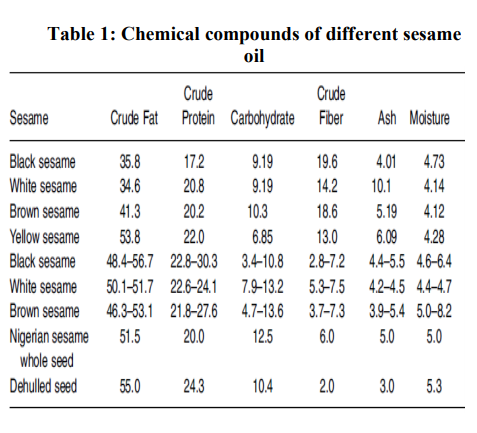
But due to difficulty in extraction, some parts of its oil are impossible to be extracted. Unlike high saturated degree, sesame oil is one of the stable oil. In recent decade, the amount of its production has grown (Hwang. 2005). The chemical compounds of sesame oil contain protein (%18-25), carbohydrate (%13.5), and ash (% 5) (Borchani and et al. 2010). Table 1 shows different compounds in sesame oil at which the amount of its oil was more than other oil sources (soybean, canola, sunflower and cotton) which is %28-59(table 1).


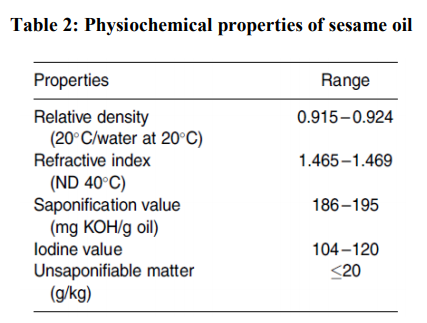
Physiochemical properties of sesame oil presented in table 2


Sesame oil belongs to oleic-linoleic acid. The amount of fatty acids has been depicted in table 3. The amount of oleic and linoleic acid are the same

Result and discussion

Processing

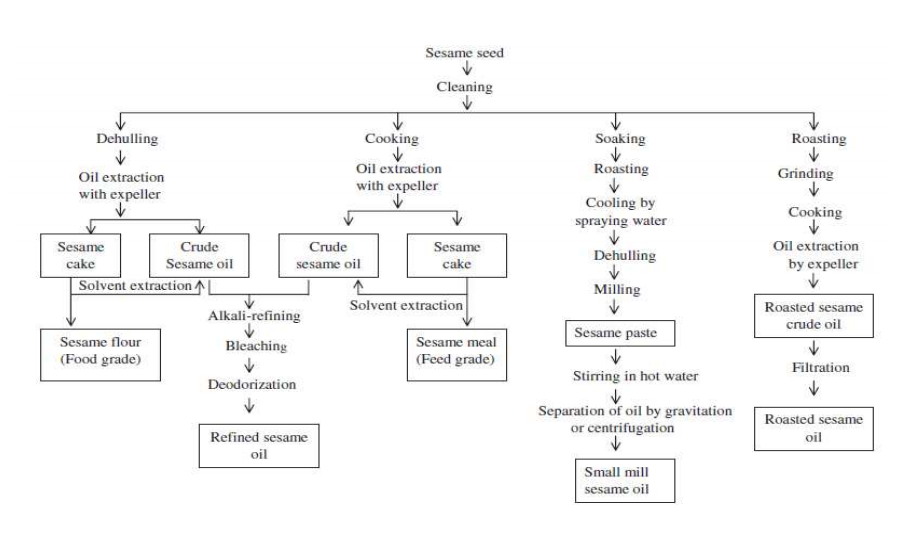
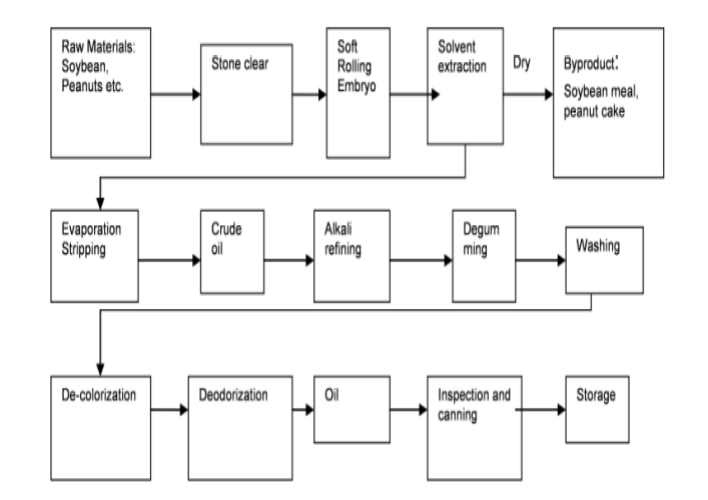
Processing is collection of measurements in order to provide foodstuff to be ready for consumption which depends on two parameters; 1) removing of seed husk, 2) fried seed. All processing methods including refining of sesame oil obtained from crude seeds (with/without husk), fried oil resulted from fried sesame, sesame oil produced from nonhusk fried sesame seeds.

Fig.1: Diagram of different sesame oil processing


Peeling

Husk peeling is essential as a result of the presence oxalic acid and non-digestible fiber. This process leads to oxalate be removed, then initial stages for providing sweet sesame with bright color, low fiber and protein provides

Oil extraction

Oil extraction using laboratory method Modern methods using normal hexane and enzyme extraction. Sesame oil extraction by subcritical CO2 has reported as well.

Industrial method

Hot water floating method

Grounded sesame seeds forms to a paste, heats to 80°C-90°C for 15min, then shakes while boiling for 15min, after cooling, upper layer removes and dried by heating, efficiency of this method is %41

Poly press

Sesame seeds smashed through a plate with mesh 2mm. In this method as much as fine seeds consumed, obtained oil has better quality. Extraction is performed through adding water (%11-13 w/w), the resulted paste dried at 70°C.

Ram press

In this method, there is no need to initial grounding,however beginning on metal sheets. Kapo press cause to produce clear oil with %57.7 efficiency.

Ghani process

12kg of seeds grounds in mill with 0.5 L water, after 30 min oil releases and temperature increases to 55-60°C causes to excretion of 5 L oil

Demanding Press machinery

This is common method in which Sesame oil can extract under low temperature condition with no touch to chemical solvents or high temperatures. After extraction, neutralization and cleansing perform to enhance oil quality .

Figure 2: Extraction of Sesame seed using press machine


Subcritical Liquid

CO2 uses as solvent along with ethanol, under 20MPa, 35°C, 5.2gCO2/min, and the process lasts 210min and its efficiency %26.47.

Soxhelet extraction

This process continues up to the level of removing oil from seeds in presence of petroleum ether and ethanol as solvent for 8hr.

Fractionation extraction

This method performs through ethyl ether, ethanol and water.

Enzyme extraction

Sesame oil extraction can be improved by adding enzyme to water solution. Sesame oil can extract by demanding different enzymes like papain, Tripsin and cellulase. Enzyme extraction in neutral condition i.e. at 50° C, 3hr, 80 rpm, enzyme amount were 6000,400 and 250U/g is %58.87.

Total conclusion

The most extracted oil was related to poly press method with %70 efficiency.
What Are the Different Uses of Sesame Oil?


Ask people how to use sesame oil and the most common and obvious answer will be for cooking. There are, however, other uses for this type of oil that do not involve food. In addition to cooking, it may also be used for massages, treating dry skin, and in organic insecticides. Even pharmaceutical companies use sesame oil in intramuscular injections.

One of the most popular uses of sesame oil is in the preparation of some types of food. This is particularly true in certain parts of the world such as South India, China and Korea. Sesame oil can be used in making stir-fry dishes, marinades, salad dressings and even for frying. The taste of the oil varies depending on its color. Lighter oils tend to be mild, while darker oils have a more intense flavor and are used primarily when preparing Asian dishes.

Another of the more popular uses of sesame oil is as a topical treatment for the skin. Its emollient properties may help soothe and moisturize dry skin with regular applications. People who are suffering from body aches or anxiety may also benefit from its use. Sesame oil often serves as a base oil for massages and can be mixed with oils that are too irritating to use on their own.


Ad


There are multiple benefits when it comes to the dietary and topical uses of sesame oil. It is rich in antioxidants, including vitamin E. Sesame oil also contains both monounsaturated and polyunsaturated fats that may help in lowering high blood pressure.

Prior to implementing any of these uses of sesame oil it is important to determine if there is an allergy or sensitivity. People who are allergic to sesame seeds should not use the oil either topically or internally. To check for potential skin allergies, apply a small amount of the oil behind the ear and wait for 24 hours. Within that time period, check on a regular basis for any redness, rash or obvious irritation that may indicate a reaction. If diarrhea is an issue, taking sesame oil should also be avoided as it is a mild laxative and can worsen the problem.

Some of the lesser known uses of sesame oil involves insecticides and injections. In terms of injections, it is often used as a carrier for certain types of intramuscular injections. Intramuscular injections are injections that go directly into the muscle. Medications, such as progesterone for fertility treatments, are made using an oil solution. Sesame oil may also be used in the manufacturing of insecticides. It is considered a minimal risk active ingredient and is frequently used in organic insecticides.

Improved Sesame Oil Production Line Introduction


The sesame oil production line has been improved by combining modern hydraulic oil pressing workshop with traditional roasting, dedusting, and cooling methods. In the sesame oil manufacturing process, it combines modern pipelining production with traditional frying equipment, which can not only increase production efficiency but also preserve traditional flavors. The superior oil production line not only retains the effect of roasting and dedusting on the fragrance of sesame oil in the traditional process but also reduces the time and space occupied by traditional techniques such as grinding, stirring and oil oscillating separation. Moreover, the improved oil pressing line also has features of modern hydraulic press technology, such as a high degree of mechanical automation, high production efficiency, etc.

Steps of Sesame Oil Hydraulic Production Line


Sesame seed selection has a great influence on product quality, and the main purpose of selecting is removing impurities and immature seeds. First, choose mature sesame which is full, moderately dry and wet; then use magnetic separator, screening machine, stoning machine and winnowing machine to complete the process of material feeding, screening, stone remover, magnetic separation, and complete process of dust-removing and air purification, which can reduce the damage to the subsequent machine.


Advantages of Improved Sesame Oil Production Line


1.Our improved oil hydraulic pressing process adopts high-low temperature combined baking method, which can minimize the loss of protein content in sesame seeds and other nutrients (such as vitamin B and linoleic acid). At the same time, the oil production rate is increased and the production cost is reduced. The structure of the national edible oil is improved: the oil could be also used for cooking and eating, while not limited to seasoning.
2.The modern pressing workshop’s oil output rate is 2 to 3 points higher than the traditional oil output rate. And it is labor saving: For small-scale oil manufacturing, 1 to 2 people can organize the entire pressing workshop.

Application of Sesame Oil Production


Sesame oil


sesame oil

Sesame oil has a wide range of application. In addition to seasoning food, sesame oil is widely used in health food, medicine, metal, printing, and dyeing industry. Sesame oil, like olive oil and peanut oil, is an all-natural oil that can be used directly without chemical refining.

Oil cake


Every time the oil is finished, it will produce a lot of oil residue. We can use the oil residue again to make some special snacks, such as sesame cake, etc. Residues can also be used to feed chickens, fish, flowers. Since there is also a large human demand for oil cake in the market, our sesame oil production line truly realizes high output and low consumption.