1.Camellia oleifera (Camellia oleifera)
Perennial evergreen shrubs or small trees of the tea family, having a yellowish brown bark and smooth, subdivision. Large white flowers are also known as "white tea" in autumn. It is a unique woody edible oil plant in China and the most important edible oil tree species in the low hilly areas of the south of the Yangtze River. It has been cultivated for more than 2000 years in China.
Camellia oleifera grows fast, bears early fruit, has a long life span, has high quality and yield, strong adaptability, poor ridge resistance and drought resistance. It is the main tree species for rehabilitating red soil and can be widely planted in mountainous areas. It mainly distributes in 500 counties (cities) of 15 provinces, cities and autonomous regions in subtropical areas. The cultivated area is about 4 million hectares (60 million mu), and the main type is common Camellia oleifera. Hunan is the most widely planted Province in China. The cultivated area of the province is about 167 million hectares (20 million mu), and the area and output rank first in the country, accounting for 14% of the forestry land in the province, which is the largest economic forest species in the province.
The oil content of Camellia oleifera seed can be as high as 59.2%, which is one of the highest oil plants in China. Common Camellia oleifera is divided into two types: cold dew seed and box-drop seed. The annual output of Camellia oleifera is 700,000 tons, and the output of Camellia oleifera is 15-180,000 tons, ranking first among woody edible oils in the country. The content of unsaturated fatty acids in Camellia oleifera seeds is more than 90%, mainly oleic acid and linoleic acid, which do not contain erucic acid and are not easily polluted by Aspergillus flavus. Camellia oil is also an industrial oil, such as lubricating oil and rust removal.
Zhejiang Changshan County, there is a "tea king" in the late Qing Dynasty, height 5.5m, covers an area of 64m2, with an annual output of up to more than 250 kg of tea seed, tea oil production of about 17 kg. In addition to oil tea, tea tree seeds also contain oils, the kernel oil rate of about 16%, the crude oil bitter taste and smell, color is brown and yellow, refined edible. The oil extraction of Camellia oleifera seed is still the main method in China.
2. tung tree (Verincid fordli):
Euphorbia deciduous broad-leaved trees. Tungoiltree is China's specialty woody oil plant production in the world, mainly in the Yellow River in 17 provinces (regions) of the southern area of 870 thousand hectares, oil production reached 62 thousand and 460 tons. It is also known as the four largest woody oil plants in China, including Camellia oleifera, walnut and urchin. There are 6 species of tung oil grown in the world. The three year old tung tree and the Millennium tree are the most common in China. In the past three years, Tung's scientific name, tung oil tree, has been growing fast, with a high yield and a fruit bearing period of 20 to 30 years. The famous tung tree of tung tree is more than three years tall, more than 10 meters, and has a long tree age. Tung oil is the oil extracted from the seeds of tung oil tree. The oil extracted from the seeds of the tung oil tree is called wood oil, and its quality is slightly inferior.
Sichuan, Guizhou, Hunan, Hubei four provinces of China's production of tung oil, Sichuan oil production ranks first in the country. Guizhou Xiushan's "Xiu oil" and Hongjiang "Hongyou" of Hunan are the top quality of tung oil in China. Sichuan Liangshan Tung fast growth, flowering and fruiting early, high yield, oil yield more than 34%, the highest 37.8%, higher than the province inside and outside. Tung oil in Liangshan is famous for its light color and good oil quality.
Tungoiltree seed for the oil is known as the main component of tung oil, Eleostearic Acid, belonging to the unsaturated acid is excellent coating properties. Tung oil, as an important industrial oil, has a long history in China. Tung oil and wood oil are brown or golden color, excellent drying oil, shiny, not edible, tung oil has the characteristics of waterproof, breathable, light weight, good gloss, strong adhesion, no electricity, hot and cold resistance, acid and alkali resistance, corrosion resistance etc.. Widely used in paints, plastics, synthetic rubber, electrical appliances, artificial leather, synthetic gasoline, ink and other manufacturing.
3.Jatropha curcas L.
Euphorbia deciduous shrubs or small trees, also known as green wood, false peanuts, smelly Tung. It is 3-4 meters tall, has smooth bark, and its seeds are oblong, and its seed coat is gray and black. Native to Brazil, widely distributed in the tropical and subtropical regions in our country. It is mainly produced in Yunnan, Sichuan, Guangdong, Guangxi, Hainan and other provinces.
Jatropha curcas is a photophilic plant with strong and developed roots. It can grow on dry, barren and degraded soil as an oil crop with strong drought resistance and barren ability. It also has soft tissue, water content, juice, toxicity and is not easy to burn and resist diseases and insect pests because of its branches, trunks and roots. The dry hot valley in the wild seeds, usually cooked a year, less two crops a year, branch and stem with the ability of regeneration, seed germination rate was above 90%. Jatropha curcas grows rapidly and has strong vitality. In some places, a continuous forest community can be formed. It is suitable for planting in dry hot valley areas with tropical, subtropical, and harsh rainfall conditions. Jatropha curcas fruit can be put into operation in 3 years, and in 5 years.
The highest oil content of wild Jatropha fruit is about 60%, the average yield per mu of Jatropha nuts 650 kg, can be processed to extract about 180 kilograms of bio diesel". The experts are collecting Jatropha curcas resources from all over the world, the construction of the plant gene pool.
4.Light Leather tree (Corpus wilsoniana)
A deciduous tree of dogwood with a fruit period of 10-11 months. Pulp and seeds can be edible and medicinal, rich in oil, is one of the main woody oil tree species in China. Mainly distributed in south and central China, tropical or subtropical areas of Hunan, Hubei, Jiangxi, Guizhou, Sichuan, Guangdong, Guangxi. It is concentrated in the sparse forest at the elevation of--1000m. Can be planted by sowing method, light skin tree has wild characteristics, happy light, in good drainage, moist and fertile loam growth exuberant, deep root, germination, strong especially suitable for limestone mountain planting.
Wide adaptability, cold resistance, heat resistance, early, resistance to poverty bumps, is expected to produce low-cost raw materials. It was determined that the seed weight of the peel Tree 71--83 g, the oil content of the whole fruit was 30.0-34%, the oil content of the pulp was 52--55%, the seed oil content was 14--17%, and the saponification value was 195. 9; Iodine value 104--116.8; non-saponification 1.
3%. At present, Hunan Province has established a large area of light skin tree plantation base, southern Hunan,
There are large areas of mixed forests and scattered forests in Xiangxi, which provide convenience for the production of biodiesel. Compared with rapeseed, combined with China's comprehensive implementation of the conversion of farmland to forest ecological project, a large area of biodiesel raw materials forest, can change the disadvantage of barren mountains as an advantage, while providing China with the future development and use of biodiesel to provide raw material base guarantee。
Biodiesel feedstock-Jatropha seed
Jatropha curcas is originally a medicinal plant. Recently, it has been found that its seeds contain high oil content. It is one of the most studied energy plants in the world which can produce biodiesel. Jatropha curcas has high economic value and is recognized as a bioenergy tree in the world. Its seed kernel is the traditional soap and lubricating oil raw material, and has the purgative and emetic effect of tung tree seed, oil withered can be used as pesticide and fertilizer.
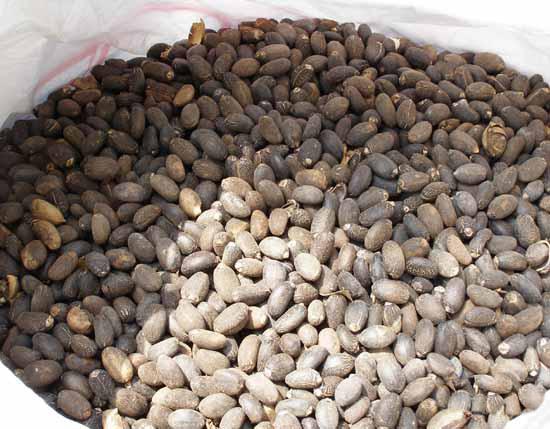
Jatropha curcas L. is a perennial drought-tolerant woody plant. It is suitable for planting in barren and marginal land. It has simple planting, extensive management and rapid growth. The Jatropha curcas L. forest can be put into production in 3 years and in full fruit period in 5 years. Fruit harvesting lasts for 50 years and the oil content of the fruit is 60-70%. The modified jatropha oil can be used in various diesel engines, and is superior to domestic zero diesel oil in key technologies such as flash point, solidification point, sulfur content, carbon monoxide emissions, particle size, etc. It meets Euro-2 emission standard and is called biodiesel. Trees are the most potential oil crop varieties. At present, the dry fruit yield of wild Jatropha curcas is 300 ~ 800kg/ mu, and the average yield is about 660kg/ mu.Pure jatropha oil can be used for cooking, lighting or power generation. A range of by-products include glycerin for cosmetics and reprocessed jatropha seed cakes that can be used as organic fertilizers. Its seed oil residue, residual oil residue and leaves can be used as pesticides. After detoxification, it can also be used as animal feed. Nitrogen rich seed oil residue is an excellent plant fertilizer.
Bio-oil technology is a traditional technology, but the production of bio-diesel from Jatropha curcas is a recent event. In 1995, with the support of the Rockefeller Fund and the German government, Brazil, Nepal and Zimbabwe began to develop jatropha oil as a fuel. India's Planning Commission set up a leading group on biofuels in July 2002 to draft a national development plan for biodiesel. It plans to achieve the target of replacing 20% petroleum diesel with biodiesel by 2011-2012, by which time the Jatropha planting area will reach 5 million hectares. 2003-2007 is the stage of demonstration projects, during which the government, as the primary promoter, is responsible for the planning and operation of all links. The main work of this stage is to explore the problems and solutions in the links of planting, threshing, refining, transformation, blending, market development, product quality and system arrangement. 2003-2007 is the stage of demonstration projects, during which the government, as the primary promoter, is responsible for the planning and operation of all links. The main work of this stage is to explore the problems and solutions in the links of planting, threshing, refining, transformation, blending, market development, product quality and system arrangement. 2007-2012 is the stage of independent development and expansion of production. The goal is to achieve large-scale cultivation of Jatropha curcas and to expand the planting scope to the whole country so that enough vegetable oil can be produced to produce biodiesel. According to the road map, by 2007 India will produce 1.5 million tons of Jatropha seeds, extract 480,000 tons of Jatropha oil, create 124.4 million workers in the cultivation process and 36.8 million workers annually in the threshing process, lifting 550,000 rural households out of poverty.
On the one hand, the price control of refined oil makes it impossible for biodiesel producers to transfer the pressure of cost through price increase; on the other hand, compared with the EU, the United States and other countries and regions on the high subsidy and tax relief measures for biodiesel enterprises, China has no specific and operational industrial support policies and measures. Stage.
The industrial chain of biodiesel industry is composed of upstream raw materials and technologies, equipment suppliers, middle-stream biodiesel production enterprises, downstream gas stations, power plants, refineries, transportation companies, chemical enterprises and other customers. Oil plants, ditch oil recovery enterprises, oil distributors are the main raw materials of biodiesel industry. Material supplier. The equipment suppliers include Westfalia Food Technology Company of Germany, Melloni Group of Italy, Luzi Company of the United States, Energea Biodiesel Technology Company of Austria and other international well-known technology equipment suppliers, as well as some domestic professional oil equipment manufacturers, such as Henan Xiuwu Yongle Grain Machinery Group, Wuhan Science and Technology Xin. Valley Technology Co., Ltd., Wuxi Ruizhiyuan Biofuel Equipment Manufacturing Co., Ltd., Shanghai Zhongji Environmental Protection Technology Co., Ltd. Generally speaking, the quality of imported equipment is better, but the price is expensive, and the raw material requirements are more stringent, suitable for large-scale production enterprises; while the quality of domestic equipment is relatively poor, but the price is low, the adaptability of raw materials is also strong, suitable for small and medium-sized enterprises.
Compared with fossil diesel oil, jatropha oil is a green diesel oil. It is environmentally friendly (low sulfur content in Jatropha oil, 10 times lower SO2 and sulfide emissions than 0# diesel oil), has good start-up performance at low temperature (no additive condensation point up to - 20 C), and has strong lubrication function (low wear rate of injection pump, engine block and connecting rod, long service life). High safety performance (high flash point, not belonging to dangerous goods, convenient transportation and storage), good fuel performance (high cetane number, combustion performance is better than diesel oil, combustion residue is slightly acidic, so that the catalyst and engine oil life lengthened), and has regeneration.
Jatropha curcas L. is a perennial drought-tolerant woody plant. It is suitable for planting in barren and marginal land. It has simple planting, extensive management and rapid growth. The Jatropha curcas L. forest can be put into production in 3 years and in full fruit period in 5 years. Fruit harvesting lasts for 50 years and the oil content of the fruit is 60-70%. The modified jatropha oil can be used in various diesel engines, and is superior to domestic zero diesel oil in key technologies such as flash point, solidification point, sulfur content, carbon monoxide emissions, particle size, etc. It meets Euro-2 emission standard and is called biodiesel. Trees are the most potential oil crop varieties. At present, the dry fruit yield of wild Jatropha curcas is 300 ~ 800kg/ mu, and the average yield is about 660kg/ mu.Pure jatropha oil can be used for cooking, lighting or power generation. A range of by-products include glycerin for cosmetics and reprocessed jatropha seed cakes that can be used as organic fertilizers. Its seed oil residue, residual oil residue and leaves can be used as pesticides. After detoxification, it can also be used as animal feed. Nitrogen rich seed oil residue is an excellent plant fertilizer.
Bio-oil technology is a traditional technology, but the production of bio-diesel from Jatropha curcas is a recent event. In 1995, with the support of the Rockefeller Fund and the German government, Brazil, Nepal and Zimbabwe began to develop jatropha oil as a fuel. India's Planning Commission set up a leading group on biofuels in July 2002 to draft a national development plan for biodiesel. It plans to achieve the target of replacing 20% petroleum diesel with biodiesel by 2011-2012, by which time the Jatropha planting area will reach 5 million hectares. 2003-2007 is the stage of demonstration projects, during which the government, as the primary promoter, is responsible for the planning and operation of all links. The main work of this stage is to explore the problems and solutions in the links of planting, threshing, refining, transformation, blending, market development, product quality and system arrangement. 2003-2007 is the stage of demonstration projects, during which the government, as the primary promoter, is responsible for the planning and operation of all links. The main work of this stage is to explore the problems and solutions in the links of planting, threshing, refining, transformation, blending, market development, product quality and system arrangement. 2007-2012 is the stage of independent development and expansion of production. The goal is to achieve large-scale cultivation of Jatropha curcas and to expand the planting scope to the whole country so that enough vegetable oil can be produced to produce biodiesel. According to the road map, by 2007 India will produce 1.5 million tons of Jatropha seeds, extract 480,000 tons of Jatropha oil, create 124.4 million workers in the cultivation process and 36.8 million workers annually in the threshing process, lifting 550,000 rural households out of poverty.
On the one hand, the price control of refined oil makes it impossible for biodiesel producers to transfer the pressure of cost through price increase; on the other hand, compared with the EU, the United States and other countries and regions on the high subsidy and tax relief measures for biodiesel enterprises, China has no specific and operational industrial support policies and measures. Stage.
The industrial chain of biodiesel industry is composed of upstream raw materials and technologies, equipment suppliers, middle-stream biodiesel production enterprises, downstream gas stations, power plants, refineries, transportation companies, chemical enterprises and other customers. Oil plants, ditch oil recovery enterprises, oil distributors are the main raw materials of biodiesel industry. Material supplier. The equipment suppliers include Westfalia Food Technology Company of Germany, Melloni Group of Italy, Luzi Company of the United States, Energea Biodiesel Technology Company of Austria and other international well-known technology equipment suppliers, as well as some domestic professional oil equipment manufacturers, such as Henan Xiuwu Yongle Grain Machinery Group, Wuhan Science and Technology Xin. Valley Technology Co., Ltd., Wuxi Ruizhiyuan Biofuel Equipment Manufacturing Co., Ltd., Shanghai Zhongji Environmental Protection Technology Co., Ltd. Generally speaking, the quality of imported equipment is better, but the price is expensive, and the raw material requirements are more stringent, suitable for large-scale production enterprises; while the quality of domestic equipment is relatively poor, but the price is low, the adaptability of raw materials is also strong, suitable for small and medium-sized enterprises.
Compared with fossil diesel oil, jatropha oil is a green diesel oil. It is environmentally friendly (low sulfur content in Jatropha oil, 10 times lower SO2 and sulfide emissions than 0# diesel oil), has good start-up performance at low temperature (no additive condensation point up to - 20 C), and has strong lubrication function (low wear rate of injection pump, engine block and connecting rod, long service life). High safety performance (high flash point, not belonging to dangerous goods, convenient transportation and storage), good fuel performance (high cetane number, combustion performance is better than diesel oil, combustion residue is slightly acidic, so that the catalyst and engine oil life lengthened), and has regeneration.

订阅:
博文 (Atom)