Firewood, rice, oil, salt, sauce, vinegar, tea, we can not live without oil every day, but most people eat the wrong! Did you know that years of using the wrong kind of oil can do great harm to our health? Next, ask your doctor to teach you how to eat oil properly.
Every meal is inseparable from the "oil", many people do not know about it. How many of the following mistakes did you make?
Mistake 1
Cooking oil doesn't go bad
Many people think cooking oil doesn't go bad, but they're wrong. The decline of cooking oil is frequent, even widespread. Some people are used to putting small oil pot beside hearth, convenient use. The surface of the oil pot that USES for a long time can get on many oil, the oil scale of the bottom inside oil pot is more serious.
Rancid oils smoke and choke when heated, but more importantly they produce a host of dreaded carcinogens, the more deadly of which is called epoxypropyl aldehyde.Experiments have shown that mice can develop tumors after intermittent subcutaneous injection of more than 280 mg of epoxypropionaldehyde each year.
Mistake 2
No matter how you cook it, you use the same oil
The heat resistance of different oil is different, the cook of exorbitant temperature can accelerate carcinogen to produce, bring healthy risk.
Right approach:
Frying should use the most heat-resistant palm oil, coconut oil, butter, butter, butter, lard, etc.
Fried vegetables should use heat resistance better peanut oil, rice bran oil, tea seed oil, refined olive oil, sunflower seed oil, soybean oil.
For soup and salad, use flaxseed oil with poor heat resistance, Perilla seed oil, walnut oil, virgin olive oil and so on.
Mistake 3
The Fried oil can be used to fry vegetables
Many people do not want to throw Fried food oil, will also be used for high temperature cooking or frying. This approach is highly undesirable, as the oil is heated at high temperatures to produce trans-fatty acids and toxic lipid oxidation products.
If you really want to reuse, you have to avoid reheating to smoke."Return pot oil" can be used to make soup and rolls.
Mistake 4
Put the oil pot next to the stove when cooking
Oil oxidizes easily when it comes into contact with water, air and light. In general, the higher the temperature, the longer the time of light, the greater the probability of oil oxidation. Usually each additional 10 ℃ temperature, oil rancidity rate will be doubled. Therefore, it is very dangerous to put the oil pot beside the hearth when cooking. The probability of oil rancidity rises linearly.
Mistake 5
People with the disease eat the same oil as their families.
People with heart disease should give priority to the following oils: tea seed oil, olive oil, low erucic acid canola oil, sesame oil, flaxseed oil and so on. Blood fat tall crowd, should use peanut oil less, corn oil fry fry to do dish, suggest to eat less or do not eat Fried food.
Edible oil also can go bad, and have a bad edible oil, it is possible to appear food poisoning, nausea, vomiting, abdominal pain, diarrhea and other symptoms followed. While the change in cooking oil isn't serious and won't have serious consequences in the short term, there is a huge risk of cancer in long-term consumption.
Scientists Have Turned Cooking Oil Into a Material 200 Times Stronger Than Steel
Deep Fried High-Tech
Researchers have found a way to turn cheap, everyday cooking oil into the wonder material graphene – a technique that could greatly reduce the cost of making the much-touted nanomaterial.
Graphene is a single sheet of carbon atoms with incredible properties – it’s 200 times stronger than steel, harder than diamond, and incredibly flexible. Under certain conditions, it can even be turned into a superconductor that carries electricity with zero resistance.
That means the material has the potential to make better electronics, more effective solar cells, and could even be used in medicine.
Last year, a study suggested that graphene could help mobile phone batteries last 25 percent longer, and the material has the potential to filter fuel out of thin air.
But these applications have been limited by the fact that graphene usually has to be made in a vacuum at intense heat using purified ingredients, which makes it expensive to produce.
Until we can find a cost-effective way to mass produce the over-achieving material, it’s pretty much limited to labs.
But scientists in Australia have now managed to create graphene in normal air conditions, using cheap soybean cooking oil.
“This ambient-air process for graphene fabrication is fast, simple, safe, potentially scalable, and integration-friendly,” said one of the researchers, Zhao Jun Han from Australia’s CSIRO.
“Our unique technology is expected to reduce the cost of graphene production and improve the uptake in new applications.”
The team has called the new technique ‘GraphAir’ technology, and it involves heating soybean oil in a tube furnace for about 30 minutes, causing it to decompose into carbon building blocks.
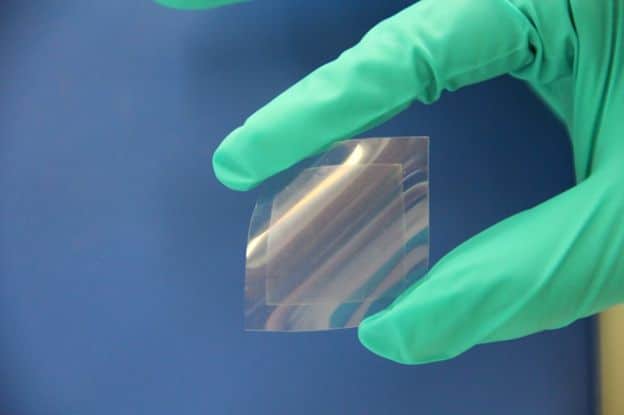
This carbon is then rapidly cooled on a foil made of nickel, where it diffuses into a thin rectangle of graphene that’s just 1 nanometre thick (about 80,000 times thinner than a human hair).
Not only is this technique cheaper and easier than other methods, it’s also a lot quicker – to create graphene in a vacuum takes several hours.
More Cheap Options
Zhao told the Australian Broadcasting Corporation (ABC) that the technique could reduce the cost of making graphene 10-fold.
Not only that, but it offers a more sustainable option for recycling waste cooking oil.
“We can now recycle waste oils that would have otherwise been discarded and transform them into something useful,” said one of the team, Dong Han Seo.
The question now is whether this new technique can be scaled up – finding a cheaper way to make graphene is awesome, but the graphene film produced so far was only 5 cm (1.9 inches) by 2 cm (0.8 inches) in size.
The team says that the largest film they can make using the technique right now is around the size of a credit card.
To really make graphene fit for commercial use, researchers will need to produce films that are a whole lot larger than that.
“The potential’s enormous,” David Officer, a graphene expert from the University of Wollongong in Australia, who wasn’t involved in the study, told the ABC.
“[But] the question will be whether you can economically scale a method like this, where they’ve sealed it inside a furnace tube, to create and handle metre-sized films.”
The team is now looking for commercial partners to pursue this goal.
But they’re not the only researchers working on it – last week, a team from Kansas State University patented a simple technique that creates graphene using only hydrocarbon gas, oxygen, and a spark plug. No vacuum required.
Time will tell if they can use it to effectively make large films of graphene in one go, but it’s nice to know that researchers around the world are working on finding a way to take this incredible material out of the lab and into our lives.

订阅:
博文 (Atom)